
Well, it's the eve of the 2012 Liberal Party of Canada biennial convention and one of the debates generating the most interest and discussion (besides the great #lpc12 vs #ott12 hashtag debate with threatens to tear our fragile party asunder) is the proposal to adopt a primary-style system (see 2, 3, 4 and 12) to pick our next leader.
It would involve creating a new category of non-member, called supporters, who could vote for the Liberal leader if they pledge they're not a member of another party, say they abide by certain Liberal principles, and agree to give us their contact information so we can send them fundraising pitches. As envisioned in the proposal, both members and supporters would cast their votes in a serious of rolling regional votes over as long as seven weeks, timed for maximum media attention.
I'm opposed; I feel its a gimmick unlikely to generate the wave of participation its proponents predict while, at the same time, further devaluing Liberal membership at a time when we need to engage, empower and grow our membership more than ever before. Canadians could care less about how the third-place party picks their leader; they care about their everyday lives and its convincing them that we genuinely care about and will fight for the issues that matter to them that will engage Canadians in the Liberal Party.I also feel our need to be seen to be bold and innovative is leading us to rush into primaries without thinking it through; I'd rather begin with a pilot project on the riding level. At our last convention we brought in bold, innovative change that we haven't even tried yet -- one member, one vote -- which opens up the leadership from a delegated convention to every Liberal member. Let's give it a try.
Proponents, such as my friend Dan "Calgary Grit" Arnold, point to the recent Alberta Liberal primary as a success, and feel the system will both generate the voter identification data critical to modern campaign as well as energize and democratize the Liberal Party, growing our supporter base and earning oodles of free media as our bold experiment captures the attention of Canadians during American Idol's off-season.
Dan and I recently went to a bar, as Liberals are known to do, to debate the issue. Also, stay tuned until the end for our predictions of whether or not the primary proposal will succeed this weekend.
Thursday, January 12, 2012
Blogger debate video: BCer in Toronto vs. Calgary Grit on primaries


Sunday, January 18, 2009
Rossi supports one member, one vote
I can't find an online version, but in an article by John Geddes in the dead-tree edition of Maclean's, incoming Liberal national director Rocco Rossi indicates support for a one-member, one vote method of leadership selection:
"The most important part," he told Maclean's, "is to give meaning to party membership." For instance, he'd like to see the party eventually drop its old delegated convention system for picking leaders in favour of one member, one vote -- the method adopted in recent years by the Tories and NDP. That Rocco is willing to speak-out on such a contentious issue when there's no formal move afoot to change the party's leadership selection rules, and before more Liberals have even learned his name, is revealing.
An encouraging signal for those Liberals, such as myself, that favour OMOV and and end to a delageted convention system that weakens the grassroots voice.
I'll sound one note of caution though, as I always do when discussing OMOV. Pure OMOV would be a negative as Toronto ridings with large memberships would swamp rural ridings with small memberships. Weighted OMOV, where a point system is employed to ensure each riding is weighted equally, is the way to go.
Under such a system, each riding would be given, let's say, 100 leadership votes. Those votes would be broken down based on the vote of their members. So if 75 per cent of riding members vote for candidate A and 25 per cent for Candidate B, that riding would cast 75 votes for A and 25 for B. In that way, Scarborough-Centre and Skeena-Bulkley Valley would have an equal say.
With pure OMOV, the danger is rural ridings become powerless given their small membership numbers, and leadership candidates spend all their time campaigning and speaking to the issues of the large urban ridings in Toronto and Montreal. Recommend this Post on Progressive Bloggers
Wednesday, December 10, 2008
We're coming for you, Steve
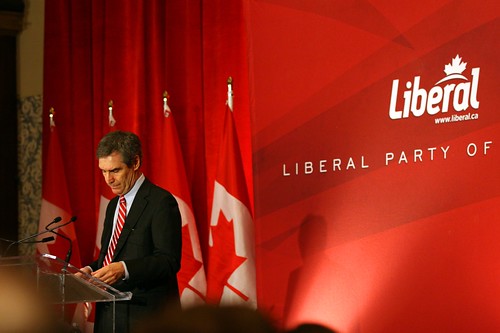
And it’s really an opportunity we have Stephen Harper to thank for. He united the right, he united the left, and now he has united the Liberal Party all together behind Michael Ignatieff to stand-up forcefully to the Conservative bullying, and quite possibly send his government packing next month. So thanks for that Steve. You rock, man.
A sincere thank-you though to Dominic LeBlanc and Bob Rae. I’ve already spoken of my respect and admiration for Dominic. And Bob really impressed me, and I think a lot of Liberals, with his selfless acts of yesterday. The odds may have been long for him but you never give up hope – look at Stephane’s improbable win in 2006 – so for him to put aside his own ambitions, and probably his last chance at the leadership, for the greater good of the party and the country was a truly noble act that I think gained him a lot of respect within the Liberal Party, including with some that maybe weren’t so sure about Bob. I have some policy disagreements with Bob, but I got to see him a few times during the election campaign when he came out to B.C. to stump for our candidates and do a few Team BC press conferences. Getting a chance to watch him work a room or the media, I have to say he’s the most skilled and natural politician I’ve ever met. The man can campaign like no-one’s business. I think he and Michael will complement one another spectacularly, and I’m really impressed with the strength of our front-bench. Particularly compared to the lack of depth across the way.
While I’d have liked a full race, there’s actually a number of positives to this scenario. If it continued, this thing could have started to get really nasty; now the wounds will be easier to heal. Not that much money has been spent yet, so debt should be very minimal and we can now focus on party fundraising. We have a leader for the long-term ready to challenge, and potentially replace, Stephen Harper.
And we can now put the focus on the more important issue facing the Liberal Party: party reform and renewal. I’ve said all along that leadership wasn’t the main problem with our party. Was Stephane a factor in the last result? Undeniably. But the problems go much deeper, and they predate Stephane, Paul and Jean. I’ve written at length already about the reforms I would like to see, and I’ll continue to push them in the months ahead.
As Jason writes today, there is now a real and meaningful opportunity to use the Vancouver convention to deliver real and substantial party reform. And as a positive, I suspect it will be a little easier now to secure a delegate spot. So, if you want constitutional reform, if you want (weighted) one-member, one vote, then it’s not enough to just moan about the need for change. Push for it. Advocate it. Get specific: what change, how and why? And, most importantly, run to be a delegate and then come to convention in Vancouver so we can VOTE for it, and really make it happen.
We have a lot of work to do, but now we’re all able to come together and get down to the challenge. And we’re able to train our guns where they really belong: Stephen Harper’s Conservatives.
And don’t kid yourself if you don’t think they’re concerned. Look at Tim Powers, already furiously trying to raise expectations (and rather transparently and ineptly, at that). They were counting on us staying divided and fighting amongst ourselves for many more months. No longer. Let’s show them what a united Liberal Party is made of. As Michael said a little while ago: no more sitting on our hands.
We’re coming for you, Steve.
Thursday, November 20, 2008
Bob and the Bloggers
 This afternoon I participated in a conference call with Liberal bloggers and Bob Rae, who announced his candidacy for the Liberal leadership this morning.
It was a well-attended call, and I commend Bob and his campaign for including bloggers that are either supportive, neutral and those that, like myself, are supporting other candidates.
For just over 30 minutes Bob took questions from those on the call on a wide-range of topics, from Afghanistan and the Green Shift to party reform and his economic record. It was a good call, and he handled all the questions thrown at him with ease. A number of accounts have been posted already (which I'll link to below) and I'll generally leave it to others to post on their questions and I'll just post on mine, and a few other points that stood-out for me.
Economic myth-making
On the issue of his economic record , and particularly this poll that indicated he ranked as Canadian's last choice amongst the current Liberal leadership candidates on the economy, Bob said he would counter his perception by being very direct about it.
“I'm going to talk about my experiences, not just in government but in a whole range of things, and talk about how that's all relates to where we are today and where we need to be. I think there's an incredible amount of myth making and mythology about what happened and what didn't happen. I just think we've got a job to do, to talk to people about what happened, and also to talk to people about a bunch of other things that happened, and how we have to move forward as a country."
"Now, I don't intend to spend the rest of the campaign talking about what happened in 1992. I'm just going to say look, we did some things right, we did some things wrong, and I doubt there's a politician or a premier in the country who wouldn't have to say that if they're being honest. And I think a lot of it is being hugely and totally exaggerated in a very propagandistic way. And certainly I'll fight back, because I refuse to let myself be defined by what various other interests might say about that time.”
We've certainly seen in media coverage the past few days, and today, that Bob intends to flip this issue on it's head, and use his record governing Ontario through recession to make the case his experience makes him the candidate best able to govern Canada through this recession.
That's certainly a bold strategy, and a valiant attempt to turn one of his potential biggest weaknesses, his record as Ontario premier, into a strength. The downside, of course, is that by putting his record on the table in support of his candidacy, it makes a critical examination of that record fair game. For example, while I agree there has been a certain degree of myth-making that has come to surround his tenure in Ontario, it's not myth to say the provincial debt doubled under his tenure, that university tuition increased 42 per cent from 1990 to 1994, or that during his tenure Ontario lost 350,000 jobs. If he's going to put his record on his table, then talking about that record needs to be fair game.
So, Bob putting his economic record on the table himself and using it to bolster his credentials, and opening that record therefore to more scrutiny and criticism, is a gutsy strategy indeed. It will be interesting to see how it plays out.
Party Reform

Bob spoke in support of a 308-riding strategy, emphasizing we don't just need a new leader and a new coat of paint, which is absolutely right.
With my question I pitched Bob on one of my pet ideas for party reform and grassroots engagement that I've blogged about in the past. The political parties get a per vote subsidy from elections Canada, currently its about $1.90. Currently, the Liberals split it between the LPC and the provincial wings (LPCO, LPCBC, etc.). I'd like to see riding associations cut in for a per centage share of the subsidy.
It's about motivating and energizing "no-hope" rural ridings, like the one I came up through in BC. In these ridings its tough to get people motivated knowing there's no way in hell we'll ever elect a Liberal. But, if the riding had a direct fiscal stake in the result (a fixed % cut of the per vote subsidy, which naturally goes up the more people vote Liberal in the riding) then you're giving them a direct motivation to push harder to get out more votes.
There are thousands of votes we could get in rural ridings across Canada (either Liberals staying home or soft NDP, Green or Cons), and while it's not enough to flip the riding, every vote does also mean more money for LPC central. So, in effect, any $ central loses by cutting in the ridings for, say, 10% or 20% of the subsidy, would likely be made up by the fact the pie would be made larger by the greater riding-level effort. So it would likely be revenue neutral for LPC, if not a profit.
And besides motivating no-hope ridings, the money would also enable ridings to do more organizing and outreach between campaigns, which will mean better results next election, snowballing each time, until some of these no-hopes may eventually come into play.
So it's not so much about fund raising, really, but about grassroots engagement.
Anyway, I outlined the idea to Bob, and asked him if he'd be supportive of such a proposal. I'm pleased to say he answered:
“I'm strongly in favour of that.”
I was pleasantly surprised to hear Bob come directly out in support of the idea. I intend to keep pushing the idea, and I hope he'll take it and run with it too.
When I met Dominic LeBlanc a few weeks ago I pitched the idea to him as well. He didn't commit but he was intrigued, particularly about the idea of incentivizing rural ridngs. I noticed that, at the LPCO debates last weekend, he picked-up on the idea if pushing harder in rural riding meaning more moves meaning more per vote funding for the party. So, I hope Dominic will come all the way around on this.
I haven't had a chance to make the case to Michael Ignatieff yet, but when I do I shall report back on his thoughts, whatever they may be. But I'm buoyed by Bob's support and Dominic's interest, as I think such an idea could be a real game-changer for rural Liberal ridings.
On with the conference call though. I also asked Bob about ideas for engaging and enabling rural riding associations. He went on to answer at length:
“I hadn't intended to get into some of the details around some of the things I want to talk about around party reform, but I think we need a completly new, fresh approach to party financing. I think the riding associations need to be given a stake in the success the party has in getting strong votes out.”
“I think we have to broaden the base of the membership substantially. I argued this morning we should not be charging for memberships. I think it's unnecessary – if it's any kind of barrier to people joining, we should get rid of it. I think the key is to go from saying are you a member, ok are you going to become a volunteer, ok are you going to be a contributor. I think we really need to look hard at the best social marketing and other techniques we can find to get people to be interested in joining up, then seeing what the benefits of membership are, and then once they see the benefits of membership they'll participate in other ways, in terms of volunteering and financially.”
“We absolutely must have a 308-seat strategy. It can only be successful if the riding associations are successful. We can't have successful national campaigns without stronger riding associations. I think we need to do a thorough look at what the finances of the party are, from the point of view of local riding associations.”
“As someone who has seen other parties at work obviously, my sense is the Liberal Party as got a bit too many layers, and the party suffers from what I call titleitis. It's got too many people who are looking for titles, and titleits is not a sign of organizational house. It's a sign of people looking for position rather than looking to have a broad-based, flatter organization with much higher levels of participation and much greater attention being paid to the finances of the local parties.”
I agree with nearly everything Bob said here, particularly about titleitis and too many layers of party structure. I disagree though on free memberships. I think membership needs to be more easily obtainable, and I think the price should be low, cost recovery only. Frankly, the LPC needs the cost recovery. But I really don't think $10 is a barrier to entry, and something free is perceived as being without value. That may be the perception of a Liberal membership today anyway, but that's a perception we also need to change.
OMOV
 Near the end as time was getting tight, someone asked Bob if he supported one member, one vote. He answered unequivocally in the affirmative.
I didn't get a chance to clarify, and I'm hoping his campaign can clarify this for me (I'd be happy to update with said clarification), if Bob meant pure OMOV or weighted OMOV. The difference is not trivial.
With pure OMOV, a large riding association in an urban centre such as, say, Scarborough, would overwhelm and drown a small riding association such as, say, Vancouver Island North. This would give disproportionate power to large urban ridings in Toronto, and it's why I don't support pure OMOV.
I do, however, fiercely support weighted OMOV, which would see each riding association granted the same number of leadership votes, with those votes apportioned based on the votes of its members, whether it be 100 or 1000 members. In this way, urban and rural ridigns are equal, and must be equally wooed by leadership contenders.
So, whether Bob supported pure or weighted OMOV will determine whether I am pleased or concerned about his answer here.
Wrapping
There were a number of other questions and answers, but I'll leave it to the other bloggers to report on their own questions. For myself, I found it a worthwhile and interesting call. I found Bob as well-spoken and articulate as always, and I appreciated his frank and honest answers and that he didn't duck a one.
I still feel Michael is the best choice for leader, but I left the call with a better understanding of where Bob is coming from and where he would take the party, and found common ground with him on a number of issues. I look forward to the campaign and the debate ahead, and our party's future wherever it may take us.
For more on the call, visit Calgary Grit, Scott Tribe, Danielle Takacs, Liberal Arts and Minds, Impolitical, Saskboy and James Bowie. Recommend this Post on Progressive Bloggers
Monday, October 15, 2007
Paging the Liberal platform committee...
Came across this article on Public Eye Online from a few weeks ago. It’s an interview with Liberal MP Dominic LeBlanc, vice-chair of the party’s policy and platform committee, in which he promises the party’s platform would be ready in time for Harper’s speech from the throne…which, of course, is happening Tuesday.
In the interview, LeBlanc hints at a few likely areas of focus, such as health care, post secondary education, working families, child poverty, senior citizens, sustainable development and, of course climate change. I’ll welcome renewed attention to child poverty, as it’s an issue Dion talked about during the leadership campaign but hasn’t much since. Also, I’d be interested to see what they have on post secondary education, as when I interviewed Dion during the campaign he wasn’t keen on wading too heavily into an area of provincial jurisdiction.
I was particularly pleased to read this from LeBlanc:… a national election platform can't answer every problem and speak to every regional issue. We have to come up with a number of coherent, cohesive national themes that reflect concrete policy proposals that can be understood by the vast majority of Canadians. Previous platforms - when the Liberals were in government - tended to look like Throne Speeches or federal budgets. A Liberal Party campaigning from opposition needs to realize that we're not tied to every department of finance memo that was ever sent around three years ago.
Hear, hear, Dominic. While a five priorities approach a la Steve Harper is simplistic and inadequate, the Paul Martin one million priorities approach leaves you appearing directionless and pleases no one. A middle ground is needed, and a focused platform guided by an overarching vision for the country is key.
After the GG delivers Harper’s throne speech tomorrow, I hope Stephane Dion and the LPC will be front and centre with the fruit of LeBlanc, Bob Rae, and the rest of the platform committee’s labours. Let’s put aside the strategy and the back and forth for a bit, and let Canadians judge us, and the Conservatives, on our ideas. Because I think, in that arena, we have the potential to really excel.