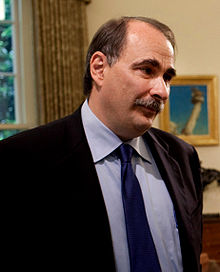
On Tuesday I attended the Exceptional Speaker Series in Toronto; it's a fundraiser for Reena, which provides support children, adults and senior citizens with developmental disabilities. Hosted by National Post publisher Paul Godfrey and moderated by former Ontario PC leader John Tory, the keynote attraction was David Axelrod, a former political strategist and senior adviser to U.S. President Barrack Obama.
It was a fun evening. Axelrod and Tory had a good back and forth; well, more Axelrod taking some fun shots at Tory, as you'll see in the Storify of live tweets of the event.
Another interesting occurrence: one of the questions from the audience turned out to be from Sun columnist (and former Ontario Conservative candidate) Sue Anne Levy, who decided to direct her question to Tory instead of Axelrod. It was the day of the AG's gas plant report, and Levy asked Tory what he did to "inflict Dalton McGuinty" on Ontario, with his gas plants and what not. The audience quickly began to drown her out in a chorus of boos, Tory declined to answer, and Axelrod, who had pointed out the "frantically waving" person who wanted to ask a question, joked he would no longer point out frantically waving people.
Really, though, the theme was leadership, and making the difficult decisions in the face of political adversity. Axelrod lamented the impact his industry has had on politics, leading politicians to put polling ahead of principle. He offered some interesting anecdotes from inside the Obama administration as they pursued health care reform. There were heated internal debates all the way through, and several times Axelrod and others advised the President to abandon the effort, warning it could cost him re-election. But Obama refused to change course, saying this was about something bigger.
Political leadership isn't about winning, said Axelrod, it's about putting principle ahead of personal interest. It's something we need more of in modern politics. Of course, you have to win to have the chance to lead. Tory's own run in Ontario on separate school funding was a principled position (I think he should have stood on ending funding instead of extending it to all) that, arguably, cost him the election. So I'd say there are no easy answers here, except to say for principled politicians to succeed, we need engaged citizens to value principled politicians.
With the U.S. government shutdown ongoing, Axelrod also had some interesting comments on current affairs in Washington. He took a few shots at Tea Party Calgarian Senator Ted Cruz, saying Canada is certainly not the lesser for his renunciation of Canadian citizenship.
But more interestingly, he observed that what is happening in congress (a minority of Tea Party Republicans hijacking the party and the agenda) is happening, in part, because political rewards in their system aren't aligned properly. These politicians are in safe seats, so there's no risk there. And they're happy to stay in the minority and take extreme positions, so there's no need for them to moderate in order to appeal to a broader constituency.
It leaves the broader Republican party in a bind. Axelrod said the leadership is taking steps to make it easier for a moderate candidate to win their next presidential primary, including having an earlier primary so the candidate (who probably had to go right to win) will have more time to pivot to the centre once nomination (as Romney tried and failed to do). The problem though, he said, is Republicans have a "Cruz missile" heading their way.
With all the madness happening in Washington DC at the moment with the government shutdown and Tea Party-driven Republican lunacy, it's opportune timing for David Axelrod, a former senior advisor to US President Barrack Obama, to be coming to Canada for a speech and Q&A.
Axelrod is keynoting on Oct. 8th at the Reena Foundation's 1st annual Exceptional Abilities Event. It's a fundraiser for Reena, a non-profit social service agency dedicated to helping children, adults and senior citizens with developmental disabilities realize their full potential and become integrated into the mainstream of society. Funds raised will support their respite and enrichment programs, where the people Reena serves can learn life skills and social skills.
Axelrod's presentation is entitled "Speaking on America's Future and Leadership Lessons" and includes q&a; I suspect the shutdown will come up and his perspective should be interesting. Axelrod was a senior advisor to Obama's campaign, transition team and, later, the White House. Today he's director of the Institute of Politics at the University of Chicago.
Unfortunately I fell out of my diligent note-taking habit around day four, so my recollections of the last three days of the trip will be a little less detailed than the first three, as I'm going more on memory.
We left Jerusalem this morning though and headed west down the highway toward Tel Aviv. First, though, we made a detour into what is essentially a Jerusalem suburb to visit Har Adar, a growing commuter community and also a hilltop battle spot that was fought over both in the independence war and in 1967. And it was also the home of our Israeli guide for the week, Lior, and a rare example of a gated Israeli residential development.
One theme we heard a lot during the week, and it may have more do to with settlement expansion than any political motivations, is housing costs. The cost of living in Israel has become very high, particularly for young people and new families. Land is at a premium, particularly in Jerusalem, and that has driven housing prices very high throughout much of the country. Development began in Har Adar as a Jerusalem bedroom community some years ago, attracting young families with the prospect of higher quality of life at affordable prices near the city. It's proximity to the green line and Palestinian communities at first turned some people off, but the price was right and now the community is thriving, has expanded to the other side of the green line, and prices are now as high as elsewhere in the country. And those early movers have seen their investments increase substantially.
At the centre of the development is a mountain-top is a former British and later Syrian military position, that was hard-fought for during the independence and 1967 wars, housing a Syrian radar position when it was finally captured by Israeli forces in 1967. Today, in addition to a stylized look-out tower, bunkers are visible and a number of 1947-era tanks and military vehicles are on display.
We left Har Adar and continued toward Tel Aviv, stopping to visit a hospital in Holon that's home to the Save a Child's Heart project. The hospital itself was interesting. A little old-looking, but the only hospital I've seen with a mall, food court and McDonald's in the lobby. As well as a metal detector at the door, but that's standard in public places here.
Anyway, Save a Child's Heart is an Israeli not for profit organization that provides over 200 surgeries yearly to infants and children from underprivileged areas around the world needing cardiac care. Children are brought to Israel for surgery, some procedures are performed in their home countries, and medical staff also work to develop cardiac care capacity in developing countries.
While we were there we saw children from Iraq, from Africa, and from China who had been brought here thanks to the program, and the donations it receives, to get life-saving care. The program also regularly treats many children from Gaza and the West Bank, whose local doctors refer them for treatment and follow-up.
The doctors and staff we spoke to, all of whom volunteer their time to the program to keep the costs down and help as many children as possible, say the program has nothing to do with politics. They keep politics out of these doors. It's about helping children in need, period. And maybe, they said, if we just focus on doing the right thing, the rest will sort itself out. A noble and perhaps naive sentiment, but perhaps not a misplaced one. While we'd heard from other speakers that Palestinians seen co-operating with Israelis risked blow-back, it seemed parents didn't hesitate bringing their children here for treatment. That's because, to a parent, a child's life is way more important than politics. So, just perhaps programs like this, and just putting everything else aside to just do the right thing, is really the key to peace in this region.
Continuing into Tel Aviv, our next stop was at Project Better Place in Pi-Gillot. It's a Palo Alto, Calif.-based start-up developing and marketing the infrastructure necessary to support electric cars. It's founded and led by Israel's Shai Agassi, a name I recognized as a former senior executive and one-time heir apparent of software firm SAP AG, a company I regularly cover in my day-job and whose Sapphire user conference I'm attending next week in Orlando.
Better Place sees the Israeli market as ideally suited to test the electric car concept – it's a small, westernized, modern country, where driving anywhere in the country doesn't take too long at all. And since the major oil producing-countries aren't all big fans of Israel, to say the least, it's a country with a vested interest in lessening its petroleum dependance.
We got the marketing video, and were told Better Place is building charging stations in public places across the country. It's also building robot-controlled battery changing stations – a car drives in over a bay, a robot reaches up to swap the battery, and you're off and driving in minutes. That's the promise, anyways.
Beginning next year, they plan to begin selling subscription packages that include the car and maintenance, power, and a charging station at your home and one public place of your choice, such as your office. You simply tap your smart card on the charger, plug in, and you're good to go.
A few problems with all this I see. For one, they're not telling us the price yet. I wonder what the cost is for all that hydro? And secondly, for all their talk about going green, and the nice clips in the video of windmills and solar panels, the fact is such technologies can only provide a fraction of our power needs today. The majority of Israel's power-generation is coal-based – hardly green energy – and a massive electric car network would only require more and more coal to be mined and burned. So, not to say this isn't worth doing, and certaintly the declining supply of petroleum is another factor, but aren't we really just transferring the pollution from the tail-pipe to the power plant?
Anyways, putting all that aside it was time to test drive a prototype electric vehicle on Better Place's test track. A former fuel-burning Renault converted to electricity to test the concept and infrastructure, getting started was a little different. No engine to turn over to start, you just press the on button and then another button to but it into gear. After that, it was like any other car. It had a good amount of pep and acceleration, comparable to any other similar car. And while it wasn't loud, it wasn't the stereotypical silent stalker either – I could hear the engine purr as I accelerated.
So, it's an interesting concept and I certaintly wish them luck. I'll be interested in seeing their pricing model. For now though, while the concept may work well in a small country like Israel, I see some challenges applying it to Canada.
After they made me park the car, we headed into the city for lunch with two Canadian-born journalists now living, and blogging, in Israel – Lisa Goldman and Karin Kloosterman. Kloosterman runs Green Prophet, an environmental news site for the Middle East, while Goldman blogs and writes for a number of local and international media outlets on a number of topics, including the Lebanon War.
It was very interesting to hear the perspectives of fellow Canadians who are now living and working in the region on the topics we'd been hearing about during the week. In particular Goldman, who I'd place firmly on the left, I thought provided some fascinating and important counter-points to some of what we'd heard from Yossi Klein Halevi and Khaled Abu Toameh.
Before lunch though we visited Rabin Square, and the site where former Israeli Prime Minister Yitzhak Rabin was shot and killed in 1995 by a right-wing Israeli radical opposed to the peace process. It's hard not wonder how history would have unfolded if not for that unfortunate event. And it's an important reminder that extremists lurk on all sides, and that on both sides there is certaintly no unanimity of opinion on the way forward.
We returned to Canadian soil briefly in the afternoon – or Canadian air, I suppose, since our Tel Aviv embassy is on an upper floor in an office tower. Our briefing and conversation with our ambassador to Israel, Jon Allen, was off the record so I can't share the details. I did, however, appreciate his frank thoughts on the issues in the region, and on Canada's evolving policy here.
After some time to relax, explore and hit the beach in Tel Aviv, we went for dinner with Shmuel Rosner, blogger and columnist at Jpost.com. The restaurant was on the upper floor of a modern, newly-opened mall with all the usual Western chains – including the country's first H&M – which sparked an interesting conversation for one of our other dining companions, a Canadian now living and raising his family in Israel – with the Westrification of Israel, is the next-generation losing touch with the challenges and hardships faced by previous generations in founding, protecting and building this country?
It's an interesting question. We'd also heard during the week that the more and more of the younger generation are looking for, and finding, ways to avoid the country's mandatory army service. Spending only a few days in the country I'm not really qualified to comment on societal trends, but I submit that maybe it's a positive that the people now longer feel the need to defend their country's existence so resolutely – they take it as a matter of fact. As for the Westrification of the culture, certaintly that has its downsides. I can't help but think though that a few H&Ms in the West Bank and Gaza wouldn't be a bad thing.
We also had some interesting conversation with Rosner on his experiences living in the U.S. and covering Barrack Obama's campaign for the presidency as a journalist. Rosner shared the view of many Israelis we spoke to on Obama – that he's tilting the balance too much toward the Palestinians and that his approach to the Iranian threat is off-base. There's a disappointment here that Obama's desire to reach out to and repair America's relationship with the Arab world has meant a less full-throated support for Israel. I submitted that America having a better relationship with the Arab world would be a positive for Israel, and for peace, in the long-run. That contention was acknowledged, but I suspect it may be a little too long-term for some here.
Sadly, our time in Tel Aviv was very short. Tomorrow, we drive North to meet a female Arab sportscaster in Nazareth and took take a peek into Southern Lebanon from Misgav Am, ending the day at a beautiful resort in the Golan overlooking the Sea of Galilee.
My second day in Israel was also spent in Jerusalem. This day was a little more heavy on briefings, and a little less heavy on the tourism. A few of the briefings were off the record so I can't share the details. They did, however, provide some insights both on Canada's development activities in the West Bank (active around justice) and Gaza (negligible due to inability to work with Hamas), as well as the Israeli government perspective on lawfare and Canada's policy on the Middle East. I can't share specifics, but it will help to shape my later conclusions.
The day begin with a briefing and a tour of Israel's Supreme Court. The contrasts to the Canadian system were very interesting. Their justices are appointed by a panel that includes both government and opposition politicians, current judges, and learned members of the legal community. The politicians are a minority on the panel; some want to change that due to the sweeping power of the court here, while others argue against politicization.
The court heard 12,000 cases last year, a number which I'm sure would put our Supreme Court to shame. There's two reasons for the high number. One, most cases aren't heard by the full court. Most are heard by three-judge panels, although the chief justice can select larger panels of any odd number for more complicated cases.
The second reason for the high number is that, in addition to being the court of final appeal for criminal and civil cases, anyone, including non-citizens, can bring a complaint against the Israeli government to the court and be heard. For example, many cases have been heard by the court, and more are pending, on the controversial security wall Israel has built between it and select Palestinian territories. It has caused much hardship, with many Palestinians cut off from their land and their neighbourhoods by the wall/fence. The court has upheld the security necessity of the wall, but in a number of cases has ordered costly reconstruction and relocation of the wall, or compensation, when it's placement caused a burden where the hardship imposed outweighed the security necessity, and it was felt the line was drawn more for ease of constriction than security reasons.
Next we headed over to East Jerusalem, the Arab-dominated half of the city that could become part of a Palestinian state in any peace settlement. We went to the American Colony Hotel, a really cool, Hemmingway-esque facility, to meet Khaled Abu Aker. He's an Israeli-Arab and the director of Amin Blogs. It's a blog site for Palestinians in the West Bank and Gaza that's designed to allow the citizens to bypass the Palestinian media and publish stories the press won't.
It's not about blogging for blogging's sake, said Aker. It's about blogging for change, and using citizen journalism as a tool for social change. And he said it's about more than just ending the occupation. Bloggers criticize the Palestinian Authority over internal management and mismanagement, issues, things that impact daily life.
While blogging is still in its infancy here compared to other Arab countries, Aker said it has the potential to be an important tool for social change, and instilling democratic values, although it's still to early to gauge the influence. But he noted 51 per cent of Palestinians have regular Web access. And they can't rely on the local media, which he said routinely self-censor. There may be reason for hope though, as he said on a recent press freedom day event at his offices in Ramallah, Palestinian Authority PM Salam Fayad stopped by unexpectedly to lend his support for press freedom.
On larger peace issues, Aker said the Swiss model just won't work here. He said Israel is becoming an Apartheid State because it has no choice, and it's only getting harder with the difficulty in making peace and balancing security issues. He said he'd like to see Israel take more responsibility for the Palestinians as it did pre-Oslo, rather than ceding it to the PA. He said most Palestinians don't reasonably expect a full right of return, and most don't want to return to live in any Israeli-state anyways. What he said they want is a symbolic right of return to be negotiated and implemented.
Lastly, Aker took a different view on Obama that the Israeli-Jews we've spoken to, saying he feels Obama is prepared to listen to both sides, marking a return to the Clinton-style from the less balanced policy of the Bush years.
Later in the day, we visited the Knesset, the Israeli Parliament, and met with Labour Party MK Einat Wilf. Although traditionally a left-wing party, Labour is part of Likhud's governing coalition and Wilf's leader, former Prime Minister Ehud Bark, serves in the coalition as defence minister.
Wilf delivered a fairly frank and wide-reaching message, in-line with what we'd heard earlier from Halevi about the decline of the Israeli left, and the blurring of left/right distinctions in the country. Even for a member of a governing coalition, she delivered what from a Labour MK was a pretty strident defence of the Likhud and Netanyahu line, more strident than probably necessary by coalition loyalty alone.
She began by talking about U.S. policy under Barrack Obama, a popular topic over here, and Wilf made clear that she feels the Obama administration has made a strategic policy change to out the settlements issue front and centre. It's a change she said has nothing to do with any alleged insult of Joe Biden, and one that requires an Israeli policy response. She added the current government had frozen settlements where others had allowed expansion, but that this government got no international credit for that because it's not sees as being as committed to peace as its predecessors.
Moving on, Wilf said over the last decade she, like many Israelis, has grown disillusioned wit the peace process. The Israeli people want two states, but they wonder if some/many Palestinians will ever accept the existence of a Jewish state. She employed a break-up, scorned lover metaphor. The Israeli people were deeply hurt, she said, and aren't keen to jump into a new relationship. So if someone (like the U.S.) wants to push them into one, it had better work out because if it ends badly, they could close off their hearts for a very long time.
Iran is a popular topic over here; Israel views a potentially nuclear and stridently anti-Jewish Iran, arming terrorist groups like Hezbollah, as a real and serious threat. Wolf again here took issue with U.S. policy, saying Obama favours process and talk over actual results.
Finally, we asked a few questions on the Israeli left, and why, by and large, the left around the world tends to have strong issues with Israeli policy. Wolf made some pretty colourful comments here. She said the Israeli left is actually staunchly Zionist, while the global left is anti—Zionist. She went on to add two-thirds of the countries in the world make less sense than Israel, but no one questions them. She added the Israeli left feels isolated from the rest of the world. She said we're not just fighting about real estate here, it's about societal values, and to those who say it should just be an Arab-dominated country, she said as a woman she wouldn't want to live in any of the Arab countries in the neighbiourhood, and she wondered why the global left isn't talking about that issue (women's rights under Arab governments.)
We ended the day over dinner with Sara Miller, the editor of Haaretz.com, the Web site of the country's largest English-language Web site. Much of the conversation went of on a bit of a tangent about Web site monetization and search engine optimization I won't recount – suffice to say they seem a little ahead of Canadian media. When we got around to politics, Miller probably provided one of the first defences of the Israeli-left we'd heard on the trip at that point. As Steve recounted, she said the left has actually proven influential in that now all of the country, even the right-wing Likhud, now accept the inevitability and necessity of a two-state solution. She was also more optimistic on the prospects for peace than others, although not any time soon.
That's it for today. Tomorrow, a primer on Israeli politics, a security tour of Jerusalem, and dinner with a right-wing Israeli-Arab journalist.
B: "No, Stephen Harper. You need your own environmental policy!" S: "I'm sorry, Mr. President."
U.S. President Barack Obama (R) greets Canada's Prime Minister Stephen Harper at the Nuclear Security Summit in Washington April 12, 2010. Obama opened a 47-nation summit dedicated to keeping nuclear arms from terrorists and planned to seek momentum in his push for a new round of sanctions on Iran.
Stock-up on anti-freeze and road salt, and ensue you have lots of wood for your wood stove. Barrack Obama's Nobel Peace Prize win today means it will be a long, cold winter:
AccuWeather.com meteorologists have discovered an interesting weather correlation in light of the recent announcement by the Norwegian Nobel Committee.
The committee announced Friday that President Barack Obama is the 2009 recipient of the Nobel Peace Prize, making him the the third sitting president and fourth overall to win the award.
Interestingly enough, severe winter weather followed each of the previous three presidents' awards, which raises questions if this year will follow the same pattern.
Theodore Roosevelt won the award in 1906 during his tenure as president. The winter of 1906-07 saw a severe February 4-6 nor'easter that produced up to 10 inches of snow from Washington to Boston, according to Paul Kocin and Louis Uccellini, authors of "Northeast Snowstorms."
Woodrow Wilson won the award in 1919 while in office, and following winter saw several severe storms. A late January storm dumped ice, sleet and snow across the Northeast.
This storm was immediately followed with a slow-moving February 4-7 storm that left heavy amounts of snowfall from Maine to northern Virginia. According to Kocin and Uccellini, this February storm brought what at the time was considered "some of the harshest winter conditions ever experienced."
More recently, Jimmy Carter received the award in 2002. The North American blizzard of 2003, which lasted from Feb. 14-19, dumped between 15-30 inches of snow in the major Northeast cities. Boston had a total of 27.6 inches, 23.6 inches on February 17 alone.
AccuWeather.com will release the winter forecast on Wednesday, but preliminary reports predict a cold and snowy winter for the Northeast.
Be sure to check the AccuWeather.com winter forecast this Wednesday to see if the 2009-10 winter will follow this "presidential" trend.
That's certainty how I would interpret this passage from Brian Mulroney's speech at the big Conservative love-in tonight, as reported by CP:
A Conservative prime minister has launched a stirring defence of universal health care, and lauded Barack Obama in his bare-knuckle political battle to extend benefits to all Americans.
But it's not the current one. Brian Mulroney used a speech to 1,500 Conservative supporters to wade where Prime Minister Stephen Harper has steadfastly refused to venture: the bitter U.S. debate over health reform.
The former prime minister drew parallels between Obama's uphill fight to reform health care to his own struggles as prime minister, which may have cost him popularity but benefited the country.
"Political capital is acquired to spend in great causes for one's country," Mulroney said Thursday.
"Prime ministers are not chosen to seek popularity. They are chosen to provide leadership. . . President Obama is fighting for a form of universal health care and is encountering ferocious resistance.
"The attacks on President Obama are often bitter and mean-spirited and his approval ratings are sinking like a stone. Still, he fights on. . .
"Fifty years from today, Americans will revere the name, 'Obama.' Because like his Canadian predecessors, he chose the tough responsibilities of national leadership over the meaningless nostrums of sterile partisanship that we see too much of in Canada and around the world."
The vast, crowded hotel ballroom went silent at that part of Mulroney's speech. One woman was seen snickering.
Mulroney's eagerness to take sides in the U.S. health debate was a stark and obvious contrast from Harper's reluctance to touch that political powder keg.
Seems to me like that's a message from Mulroney to Harper: Obama is doing important things, Harper should be supporting him, and speaking-up for the Canadian system.
Because prime ministers are chosen to provide leadership.
Canada is back? Clearly, the word has gotten out in Washington, where Stephen Harper's 42-minute visit to the White House with Barrack Obama is being treated by the administration as a blow-off meeting before lunch.
With so many serious and important issues in the Canada's relationship with the US, we can't afford to have a leader that's just not taken seriously. (Clearly the money on McCurry and Fleischer was well-spent.)
Via Wells, an excerpt from the White House press secretary and State Department deputy secretary of state's briefing to U.S. reporters aboard Air Force One. This excerpt describes President Obama's meeting with "Mike" Ignatieff. No word if Iggy called him Barry...
P.S. No mention of Omar Khadr anywhere in the White House briefing. Found that interesting.
And that was the end of lunch. Then the press conference, as you all know. He then went over back to the airport and met with Mike Ignatieff and the two other members of the opposition in that briefing. And again, the issues focused on the economy. The leader of the opposition raised the concern about the danger of protectionism and sought the President’s assurance on “Buy America.” He repeated what you heard there.
Mr. Ignatieff spent a lot of time talking about the importance of bipartisanship in Canada on foreign policy and how they had made the decision to back the government on the deployment after the Manley Commission, and that they saw this as not a partisan issue; it was more important to get the country together on issues like the budget and on Afghanistan and Pakistan, and that this was a commitment that they were sharing across the parties, and that they wanted to work together with the United States.
And Mr. Ignatieff also stressed the point about the importance of not thickening the border and making sure that the commerce and people could continue to move across effectively in working together, about that.
In all these meetings, both with the PM and with Ignatieff, the President stressed the fact that he felt that having Governor Napolitano at DHS gave us somebody who was really sensitive to this and creative about how to address these issues, and suggested that she would, you know, be working with her counterparts to address those issues.
According to Liberal senator and former general, Romeo Dallaire, the US military lawyer for Omar Khadr was in Ottawa today. Lt. Commander Bill Kuebler was here to press the case of his client, a Canadian interned at Guantanamo Bay, ahead of the visit of U.S. President Barrack Obama to Ottawa, in hopes the Canadian government will make the case for Khadr's repatriation to Canada with Obama.
While Kuebler met with opposition representatives, including Dallaire and Liberal foreign affairs critic Bob Rae, it's not surprising that, according to Dallaire, the Conservatives would not meet with Kuebler.
“For the sake of clarity, specifically on what statement, aspect or precedent of international law is the Prime Minister basing his judgment that Omar Khadr was not a child soldier?”
Two weeks later, after some further prodding, the Prime Minister’s spokesman sent along a response this afternoon, reprinted as follows, in its entirety.
During their first official meeting, U.S. secretary of state Hillary Clinton and Bernard Kouchner had a wide-ranging discussion of the major global challenges, and most particularly, important international issues such as the Mideast, on which they issued a joint call for the opening of crossing points. They also discussed Afghanistan, Iran, certain African subjects such as Darfur, and the closing of Guantanamo.
Mr. Kouchner also drew Ms. Clinton’s attention to the case of Omar Khadr, the Canadian child who, as you know, was enrolled by al-Qaeda as a pre-teen. We wanted to draw the attention of the American and Canadian authorities to his case.
Yes, say Khadr's advocates, including the Canadian Bar Association. Its president wrote a letter last month to Canadian Prime Minister Stephen Harper calling for the detainee's repatriation, saying the U.S. government has flouted his due process rights.
Harper has not taken a position on the case, and has deferred to the Obama administration.
As Dallaire notes in this interview, at some point Harper and the Conservatives are going to have to do something on the Khadr file before the Americans just drop him off on our border with bus fare and run away. Hiding behind the Americans' shirtails isn't leadership.
This week I'm in Orlando reporting on an IBM conference, so I haven't been able to follow today's inauguration festivities as closely as I'd like. But I have gotten a taste, and I do have an experience to share.
As I came out of the meal hall after an early lunch, I found in the hallway a few hundred people crowded tightly around a television screen that would normally be showing commercials extolling the virtues of Lotus Notes. But instead, today the television was on CNN, and people had gathered to watch President Barrack Omaba's inaugural address.
So, I stopped and joined them, and as time went on, more and more people stopped to watch as well. Conference attendees from across America, and from around the world, putting their seminars and their networking on hold to bear witness to a moment in history. Loud and spontaneous applause throughout the speech, and a strong ovation at the end. People taking pictures of the crowd and the TV to record the moment.
It was a fun experience, and an amazing speech. While the challenges ahead will be great, clearly today President Obama has a lot of unity behind him.
I'm just back from Daisy/Warren Kinsella's US Election party (Dan was there too). Good time had by all, much drink and much merriment, and an excellent spread as well. And what a night for democracy.
Despite the polls showing a huge lead for Barrack Obama I still had a fear the Republicans might somehow pull off an upset, but this looks to be a decisive victory, at least in the electoral college. A large cheer went up in the crowd as CNN projected Barrack Obama as the next President of the United States.
I thought John McCain gave an excellent concession speech. It was humble, it was unifying, and it honoured the historic nature of this night. And, frankly, it reminded me why I used to really like John McCain, the mavericky straight-talker 2000-era John McCain.
And Barrack Obama's speech --- wow. The man can truely give a hell of a speech and tonight was a keeper. A call to unify, a call to come together to meet the challenges ahead. If you had dry eyes after that, after the story of Anne Nixon Cooper, well, I don't know how that's possible.
Tomorrow, or rather next year, the challenge for Barrack Obama truely begins. He faces enormous challenges, and tremendous hopes have been invested in him. To meet them will be a challenge, to say the least.
But tonight is a historic night. Not only for America, but for the world. I couldn't be more proud of our American cousins. This is a once in a generation chance to reshape America, and its place in the world. It's a transformational moment in history.
Tonight our hope seems a little less audacious. And I hope it inspires all of us, in the United States, in Canada, and around the world, to dream big. To be bold in our aspirations. To truely be the change we hope to see. And to believe that, no matter how big the challenge, Yes We Can.
Kishone Roy, Vancouver Sun Published: Tuesday, November 04, 2008
Barack Obama's historic campaign for the American presidency has resonated for people all over the world, and in so many ways.
For me, watching his rise to prominence has been emotional and eye-opening. It has affected me on a personal level, and his example has left me both reflective and embarrassed.
Much has been made of the fact that Obama is on the cusp of becoming the first black president in U.S. history, and deservedly so. It is a monumental achievement that has the potential to change our world forever. Personally, I also find it noteworthy that Obama has accomplished so much as a person of mixed race; with a name that highlights his ethnic roots.
Like Obama I am from a mixed racial background. My father came to Canada from India and met my mother, who is of English and Acadian descent. Unlike Barack, I stopped using my ethnic-sounding first name in favour of something more Canadian when I was young. Many people of different racial backgrounds here do the same. Race is often viewed as a group experience; it can also be a unique and personal experience for each of us. (more)
Its been eight long years since the boys said wassup to each other. Even with the effects of a down economy and imminent change in the White House, the boys are still able to come together and say...
I didn’t sign-up for the infamous get a text message when Barack Obama picks his VP thing (wasn't worth the 15 cents to me). I did, however, sign-up for the e-mail option. I would be the first to know when Barack picked his running mate, I was told.
In the meantime, I’ve been getting regular messages about why John McCain sucks and what not, which is to be expected I suppose but was getting annoying and had me considering unsubscribing. Stay the course though, I told myself, I’ll be one of the first to know when Barack makes his VP pick.
Well, I got this message at 12:54 AM EST from CNN:
-- CNN confirms Sen. Barack Obama has chosen Delaware Sen. Joe Biden to be his vice-presidential running mate. >+=+=+=+=+=+=+=+=+=+=+=+=+=+=+=+=+=+=+=+=+=+=+=+=+=+=+=+=+=+
CNN covers the conventions: the Democrats live from Denver starting Monday and the Republicans live from Minneapolis-St. Paul starting September 1 on CNN and CNN.com. http://www.cnnpolitics.com >+=+=+=+=+=+=+=+=+=+=+=+=+=+=+=+=+=+=+=+=+=+=+=+=+=+=+=+=+=+
Clicking send/receive again, and again, still no e-mails from my buddy Barrack.
And meanwhile, over at BarackObama.com they’re still teasing me:
Mainstream media 1, Web 2.0 0. Was a nice idea though. Maybe the text messagers fared better.
UPDATE: About six hours after CNN broke the news, along with the rest of the MSM, my "first to know" message finally came as I slept soundly:
I have some important news that I want to make official.
I've chosen Joe Biden to be my running mate.
Joe and I will appear for the first time as running mates this afternoon in Springfield, Illinois -- the same place this campaign began more than 19 months ago.
I'm excited about hitting the campaign trail with Joe, but the two of us can't do this alone. We need your help to keep building this movement for change.
Please let Joe know that you're glad he's part of our team. Share your personal welcome note and we'll make sure he gets it:
This story from south of the border is a great example of how parties in Canada can use viral video and Web 2.0 as a rapid response to political debates. Best of all for Liberals, it doesn’t cost anything. Wonder if we’ll see this sort of thing up here in the next campaign:
It probably seemed like a slam-dunk campaign ad: use some stock footage of kids sleeping soundly, have a gravelly-voiced actor do a scary-movie voiceover about having an experienced president in the White House, and bam -- Hillary Clinton gets a leg up on Barack Obama and inches closer to the presidency.
The only problem, however, is that the Clinton campaign chose some stock footage that had a young girl named Casey Knowles in it -- and Casey just happens to have grown into an 18-year-old Obama supporter. She saw the ad and started talking to the media about how she didn't agree with the "politics of fear" that the Democratic hopeful was using.
Not surprisingly, the Obama campaign was all over this idea like white on rice. You could almost hear the cheers of glee echoing from the other Democratic front-runner's campaign HQ when they saw the reports about Casey, and they quickly put together their own ad using the teenaged supporter. It showed up on YouTube on Friday and already has almost half a million views.
I haven’t been following the presidential primaries in the U.S. that closely, other than what I get on The Daily Show. I did flip CNN on last night while doing other things, and listened to most of a tedious concession speech from Mike Huckabee (sorry Stephen Colbert) and a bland acceptance speech from John McCain.
It being a school night I went to sleep before there were any final results from Ohio or Texas, but this morning it seems Hillary Clinton was able to pull out wins in each. It’s too bad, I’ve been pulling for Obama. And he’s still very much in it, given the delegate numbers it’s still anyone’s game.
It’s already been observed how in many ways this primary season is imitating the script for the last two season of The West Wing. And that trend shows no sign of ending any time soon. With McCain/Vinnick nominated, the Republicans get to sit back with the Democrats with Obama/Clinton/Santos/Russell slug it out towards a brokered convention.
In the West Wing, the convention deadlocks and Santos is heavily pressured to bow out for the good of the party as the young guy that has made a name for himself, the heir apparent for next time. He appears to initially agree, then reneges on the convention stage with a speech for delegates to vote their conciencse. Behind the scenes, President Bartlet brokers the support of the NY teacher’s union for Santos and the nomination is his.
While such a scenario made for good TV, in real life it’s far from ideal for the Democratic Party. They need to get a presumptive nominee soon, and it shouldn’t be allowed to come down to a brokered convention.
At this point, as I understand it there’s no math that allows either Clinton or Obama to get over the hump before the convention. That brings the un-democratic super delegates into play, as well as divisive arguments over what to do about the un-seated Florida and Michigan delegations. That, and a prolonged primary season, will weaken and divide the Democratic Party, opening the door for what seemed impossible just a year ago: another Republican presidency.
After last night, I think the pressure is going to be incredibly strong for one of the two candidates to drop out of the race and endorse the other, for the good of the party and the good of the country. It really would be the best case scenario for what should be the ultimate goal: reclaiming the White House.
The question, of course, is who. It seems like an impossible choice to make for either candidate, both are so close to the prize they can taste it. Will one of them be able to put country ahead of ambition?
For Clinton, it’s probably a harder decision to make, because for her there probably is no next time. Could she run again in four years, or eight years if Obama wins the presidency? Tough to say, four years maybe but probably not eight. Stepping aside now may mean stepping aside from the dream.
For Obama, even if it ends here it’s not over. He has vaulted onto the national stage like a bullet, energized the party and the country. He’s young, and he’d be the presumptive nominee in four years, or eight if Clinton wins the presidency. And an Obama with a few more years of seasoning would be an even more formidable opponent, and could find it easier to blunt the national security attacks.
Both also stand to lose from staying in too long. Besides weakening and dividing the party and making it easier for McCain, this race is getting nastier and nastier. The loser stands to play a senior role in the party, Clinton has been mentioned as a possible Senate Majority Leader. Those possibilities go out the window if they’ve poisoned the ground behind them.
Looking at it pragmatically, Obama stepping aside for Clinton, and joining her on the ticket as VP, makes the best sense. Party united, experience mixed with idealism, and Obama gains the executive experience as VP to be a very formidable candidate down the road. As an Obama I’d be disappointed, because I think he can take this thing, but at what price? Really though he has the lead, he has the momentum, he shouldn't have to be the one to step aside.
There’s also a lot to be said for an Obama/Clinton ticket, with Hillary as the Leo McGarry to Barrack’s Matthew Santos. The experience balancing out the youthful idealism. And as a plus, Hillary has no history of heart problems I’m aware of.
So, will one of them step aside for the good of the party and country? In the West Wing Santos said no, and he went on to take the nomination and the presidency. Despite the parallels though while Obama may be very Santos-like, Clinton is no Bingo-Bob Russell and there’s no President Bartlett in the background to play powerbroker.
While I think the pressure will be on both of them to step aside, I just don’t see it happening. They’re both too close to winning. Also, you don’t get to be a successful politician without having a healthy ego, so I don’t think either are lacking in that department.
This one will go to the convention. It will be entertaining. In another pop culture parallel though, there will be blood.
*On this whole calling for a probe into Marc Patone’s appointment by the Conservatives as a CRTC. While it is smelly that he was (briefly) a Conservative candidate, and I’m certainly open to any chance to take shots at the Harper government, I’m not sure I’m supportive of the big fuss being made here. His Conservative ties aside, I’d argue he’s qualified. Critics are saying he doesn’t have the management experience. True, but he was a broadcast reporter on the ground for 27 years. Frankly, I think we’ve got lots of media management experience at the CRTC. Maybe it’s the journalist in me talking, but I think it’s a good thing to have one CRTC commissioner that has some boots on the ground, actual newsroom experience. That said, the appointments process does need fixing, and if the heritage committee wants to talk to him that’s fine.
*By all accounts, it sounds like Kristy Duncan is a fine candidate to succeed Roy Cullen in Etobicoke North. And I’m glad to see the party didn’t dilly-dally, but made the appointment immediately after Cullen made his retirement official. It eliminated any potential questions, and gets the news of the new candidate in the same news cycle, helping to damper the another Liberal leaving spin. One concern though: it looks like the local riding association wasn’t informed before the announcement. They should have been. Hopefully this won’t lead to any ruffled feathers and mar what seems like a solid appointment.
*The knock on the Liberals is that they always campaign from the left and govern from the right. Well, I’d say centre, but anyway, Lawrence Martin says it looks like the Conservatives do much the same: govern from the centre-right (or at least pretend to) but run from the right.
*IP points the way to an interesting article from The Guardian about the similarities between the Santos Campaign on The West Wing, and the Barrack Obama campaign, and how indeed Santos was actually modeled after Obama. Art imitating life, life imitating art. Hopefully the parallels don’t go too much further though. WW producers originally had Santos losing to Arnie Vinick; it wasn’t until the death of John Spencer, who played Santos’ VP candidate, Leo McGarry, that producers decided to give Santos the win. And hopefully no nuclear power plants in Arizona will melt down or anything.
*Can’t buy a majority: According to the good folks at Decima, over the holidays the Conservatives gained a seven point lead in the polls. All they had to do was not be in the HoC or committee facing daily attacks, not have the opposition in the news, have no news stories on Mulroney and Schreiber or Lunn’s nuclear bungling or Afghanistan, get everyone sleepy from copious amounts of turkey, and force-feed them fawning year-end media interviews. And get lots of free advertising from TSN.
Oh, and spend billions more dollars cutting the GST by one point. Can’t forget that. In spite of everything, I’m starting to feel bad for Stephen Harper. He picks the week after Christmas for his big announcement, when things are slow and the media A team is on holiday, guaranteeing compliant coverage from the B team. He gets wall-to-wall fawning coverage of his tax cut, and still he can’t even scratch into majority territory on a temporary post-announcement blip.
OK, I don’t really feel sorry for him. I think it’s pretty funny actually.
*Schadenfreude: From the same polling story:
The latest poll contains plenty of bad news for the NDP. The party -- which won a historic Quebec byelection in September and hopes to take more seats in the province -- sagged to eight per cent in Quebec. The Green party had nine per cent in the province. It was almost as bad for New Democrats in Ontario. In that province, Liberals held a 40-37 lead over the Tories, while the NDP was at 12 per cent and the Green party was at 10.
*Americans: I can’t bring myself to get too interested or excited about the ongoing U.S. presidential primaries. For what it’s worth, I’m pulling for Obama. He’ll have a tough fight against Clinton, but he has a shot. I have to laugh at some of the media coverage the past few weeks though, by both our press and the American press, particularly around the New Hampshire results. They seem to be trying to spin Obama’s close second place finish as a major defeat; I guess because he pulled-out a surprise win in Iowa he was expected to run the boards. Now they’re casting Clinton as the comeback kid, because she barely managed to hold a state she once had a much bigger lead in, not to mention a lot more organizational muscle. And then there’s the tear-gate nonsense. The primary process is a marathon, not a sprint. Wake me up in a month or two.
*Resignations: MP Brian Pallister is quitting politics and won’t run in the next election. I was about to do a post on how this is another rat fleeing a sinking Liberal ship, another sign Dion is not a leader, and another sign a Conservative (or NDP) wave is about to sweep the country. Then I remembered Pallister is a Conservative, so it must just be family reasons and not a sinister conspiracy.
*National Compost: The editors at the Post are all indignant and up in arms today (not too unusual really), demanding justice in a story so ridiculous it doesn’t bare a full summary, and so much of a non-story you probably haven’t heard of it unless you read the Post or are a Conservative die-hard (all five of you). To the Post editors though, since they are obviously so concerned about this, they might want to go back and talk to their newsroom colleagues that were around in the late nineties, when the Post’s “investigative journalists” worked hand in hand with the Canadian Alliance, trying to bring down the Chretien government with the bogus crap pile of accusations known as Shawinigate. Did Post reporters ever leak information to the Alliance, to be used in QP, so they could then write about it in the Post? Umm, does a bear shit in the woods?
The Post today says: Name the guilty reporter, and let the public see what penalty has been meted out.
Actually, come to think of if, in the Shawinigate case justice was served. Chretien won another majority, Stock Day faced open rebellion in his caucus, and no one still reads the National Post.
*God save the Wii: Ending on a positive note, I enjoyed this story:
God save the Queen: She's now playing Wii
By GamePro staff GamePro (online)
SAN FRANCISCO (01/07/2008) - Queen Elizabeth II is reportedly enamored with Nintendo's Wii.
According to a tabloid source close to UK's The People, The Queen is showing signs of becoming a "Nintendo addict" after getting her aging hands on her grandson's newly gifted Wii.
"When she saw [Prince] William playing a game after lunch at Sandringham... she begged to join in," the unnamed contact alleges. "She played a simple ten-pin bowling game and by all accounts was a natural... William was in fits of laughter. He was enormously impressed at having such a cool gran."
Since 2001, Her Majesty has regularly upgraded her cell phone before deciding on a Blackberry which she uses today. She sends email (queen@england.gov maybe?), listens to an iPod, and has seemingly turned into one of these.
I just have one point of contention however, and it’s with Prince William. He thought his Gran was cool for playing the Wii? I’d say having her face on all the money was already pretty cool, but that’s just me.
Recommend this Post on Progressive Bloggers